Info on Stucco and Plastering-September, 2026-One hundred and second issue
Bubbling synthetic finish
I was so pleased to find your web site, and your offer to answer
stucco-related questions. My sincere thanks in advance, esp. since this is
such a lengthy question.
My daughter bought a 1920's vintage house in San Francisco 2 years ago. The
interior had fairly extensive updating (mostly cosmetic), but the exterior
appeared to be original, with the exception of new vinyl windows and a newly
applied coat of "paint". I say "paint" because it's not like anything I've
seen before. The underlying stucco (I assume it's stucco) has a smooth
surface. The "paint", on the other hand, is fairly thick and is applied in
a stippled manner that simulates a rough stucco look.
Anyway, during the first winter the "paint" showed signs of bubbling, and
there were spots where it actually separated from the wall. My assumption
was that the "paint" was applied when the underlying stucco was wet,
preventing it from adhering in spots. After that winter, my daughter
contracted with a painter to patch small cracks in the stucco and touch up
the areas where the "paint" had flaked off.
She's now into the 2nd winter season and the bubbling has returned. Worse
yet, the windows appear to be leaking, causing interior damage. [I caulked
around the outside window casings but didn't see any obvious signs of
cracking, so I'm not hopeful.] On my last visit to her house, I pressed
the center of one of these "paint" bubbles and water spurted out, like I had
burst a balloon. This particular bubble was about 3' above ground level and
10' from the roof line. [The roof is flat with a central drain, and was
resurfaced before the house was sold.] I didn't see any apparent source for
the water - i.e. it wasn't under a window or other protrusion, nor did I
find any stucco cracks of any significance nearby. I am at a loss to
explain it and am looking for ideas. She extended herself financially to
get into the house, so I suspect that any repairs - assuming they are
reasonable DIY items - will fall to me.
Any insights or suggestions you can offer would be most appreciated.
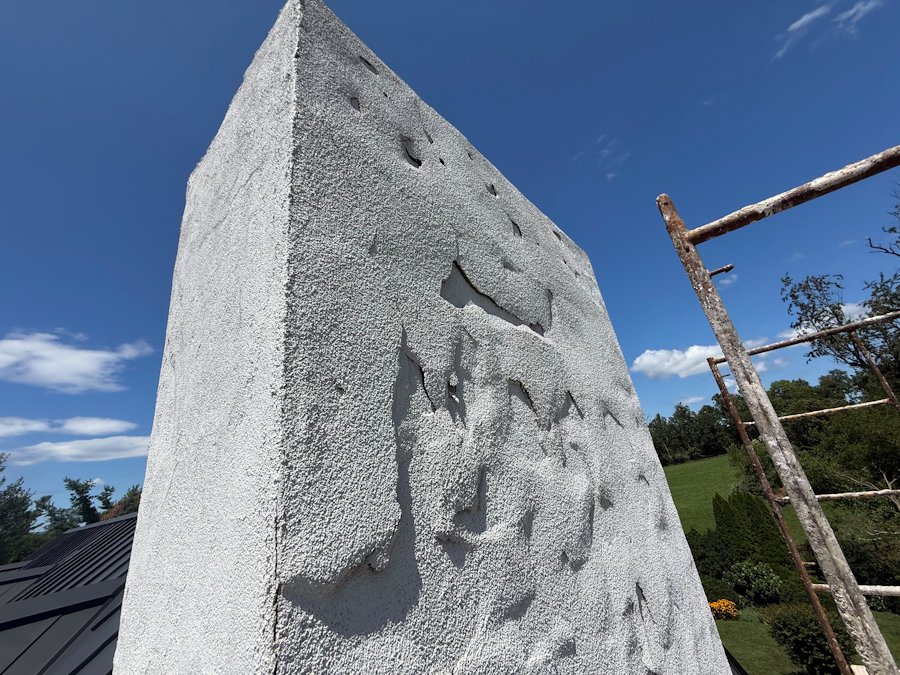
This chimney Is an example of what your house is like. Synthetic stucco finish is a stiff acrylic paint with
sand: either plastic sand or white silica sand like marble dust. This should never be used on a painted surface, even though it is common to see this done on old houses these days. The top of the chimney is porous and water runs into the chimney like a sponge. The synthetic finish is rubbery and traps water and bubbles up.
The window installation could be leaking. This could be the window leaking itself, usually the bottom corners
of the windows, or lack of flashing over the top of the window channels water into the wall.
You also may want to check the coping or drip edge on the roof or other places of water entry.
Synthetic finish is made for EIFS to be put on over styrofoam and a EIFS basecoat. Synthetic can be used on a cement basecoat
but it requires a primer or a basecoat first. I have warned before about using synthetic on a painted surface.
Bear in mind, water will penetrate stucco, even through a synthetic finish. It may not be obvious where the water is coming in.
No, this isn't a DIY project. You just want to avoid people like the ones who put on this synthetic finish.